
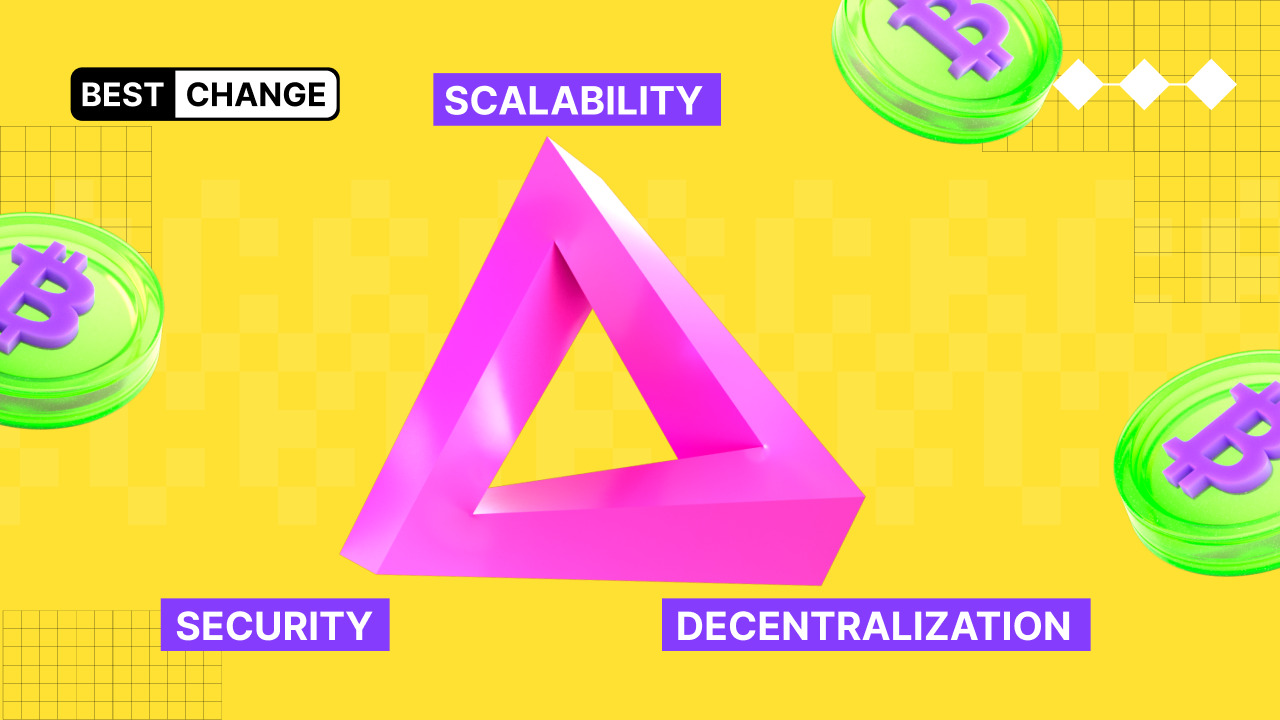
A blockchain is a distributed database that records transaction information. Unlike traditional data storage systems, it operates autonomously and is built around three key characteristics:
- scalability,
- security,
- decentralization.
It is the interaction of these three parameters that forms the blockchain trilemma*.
* The trilemma is a situation in which it is impossible to maximize three interconnected properties simultaneously: strengthening two inevitably weakens the third.
What does the blockchain trilemma mean?
The blockchain trilemma describes a limitation: a blockchain network cannot be fully scalable, maximally secure, and fully decentralized at the same time. According to the blockchain trilemma, strengthening one or two parameters comes at the expense of the third.
For example, high-performance networks such as Ethereum or Solana are often criticized for a relative decrease in decentralization.
At the same time, more decentralized networks like Bitcoin and Litecoin fall behind in scalability metrics.
The conceptual foundation of the blockchain trilemma is the CAP theorem (Brewer’s theorem), formulated in the 1990s. It states that a distributed system can simultaneously guarantee only two of the following three properties: consistency, availability, and partition tolerance. Based on this idea, the Web3 industry developed an adapted model — the blockchain trilemma.
The popularization of the term itself is associated with Ethereum co-founder Vitalik Buterin. He proposed an approach to partially overcoming the blockchain trilemma through the use of smart contracts — autonomous programs that execute transactions without intermediaries.
Main elements of the blockchain trilemma
Security
Security is the first component of the blockchain trilemma. It is ensured by cryptographic algorithms (for example, SHA-256 in Bitcoin or Scrypt in Litecoin) and consensus mechanisms*.
* A consensus mechanism is an algorithm by which participants in a distributed network (nodes) reach agreement on the validity of transactions and the state of the blockchain.
In the context of the blockchain trilemma, security reflects the network’s resistance to attacks, including the “51%” scenario*.
* A 51% attack is a situation in which one participant or a group of participants gains control over more than 50% of the blockchain’s computational power (in PoW networks) or stake (in PoS networks).
Decentralization
Decentralization is the second element of the blockchain trilemma. It implies the absence of a central governing authority and equal rights among network participants.
The higher the degree of decentralization, the harder it is to attack the system. However, a high distribution increases the time required to reach consensus, thereby reducing performance.
Scalability
Scalability is the third component of the blockchain trilemma. It reflects the network’s ability to process a large number of transactions per second (TPS)*.
* TPS (Transactions Per Second) is a measure of blockchain throughput, indicating how many transactions the network can process per second.
The Bitcoin network demonstrates a classic example of the blockchain trilemma: a high level of security limits the network’s throughput — about 7 TPS.
Modern blockchains demonstrate significantly higher metrics:
- Solana — up to 65,000 TPS;
- Avalanche — up to 4,500 TPS;
- TRON — up to 2,500 TPS;
- Layer-2 solutions* (Arbitrum, Polygon, OP Mainnet) — tens of thousands of TPS.
* Layer-2 (L2) refers to auxiliary networks or protocols operating on top of the main blockchain (Layer-1). Their task is to process part of the transactions off the main chain, reducing load on the main chain and increasing scalability while preserving the security of the base layer.
However, according to the blockchain trilemma, high throughput is often accompanied by a reduction in decentralization.
What solutions to the blockchain trilemma exist?
Layer-2 solutions and sidechains
Layer-2 networks process transactions off the main chain, reducing load on the main chain and increasing scalability.
Among scaling solutions for Ethereum:
For scaling Bitcoin, the following are used:
Sidechains* are also used — for example, Rootstock and Liquid Network.
* A sidechain is an independent blockchain connected to the main network (for example, Bitcoin or Ethereum) via a special two-way peg mechanism. Sidechains allow:
- transferring assets from the main network,
- testing new features,
- increasing performance without modifying the base protocol.
New consensus mechanisms
Some projects aim to solve the blockchain trilemma at the protocol level.
The Solana network uses the Proof-of-History* mechanism, which accelerates node synchronization.
* Proof-of-History (PoH) is a cryptographic mechanism for timestamping events within a blockchain. PoH creates a sequential time record of transactions, enabling nodes to synchronize more quickly and improving network performance.
Zero-knowledge proof technology (ZK-Proof)* is used in:
- Zcash
- Starknet
- Mina Protocol
* ZK-Proof (Zero-Knowledge Proof) is a cryptographic method that allows verification of information without revealing the information itself. Blockchain is used to enhance transaction privacy, optimize computations, and scale the network.
This approach not only helps address the blockchain trilemma but also strengthens privacy.
A hybrid model is used by BNB Chain, applying the Proof-of-Staked Authority (PoSA)* algorithm, which allows blocks to be created approximately every three seconds.
* PoSA (Proof-of-Staked Authority) is a hybrid consensus mechanism combining: Proof-of-Stake (PoS) — validation through token ownership; Proof-of-Authority (PoA) — validation through trusted validators. PoSA enables faster block creation while maintaining a certain level of security.
Sharding
Sharding* is another way to mitigate the blockchain trilemma. It involves dividing the network into parallel segments (shards), each of which processes its own stream of transactions.
* Sharding is a scaling method in which a blockchain is divided into multiple parallel segments — shards. Each shard processes its own set of transactions and stores part of the network’s data. This increases overall throughput without requiring every node to process every transaction.
The mechanism is implemented in:
- NEAR Protocol
- TON
- Ethereum
The implementation of sharding allowed Ethereum to increase performance from 15 to over 200 TPS.
Modular blockchains
Modular architecture offers another approach to the blockchain trilemma. In such networks, individual protocol components can be upgraded independently without disrupting the entire system.
Examples of modular solutions:
- Celestia
- Validium
Modularity increases architectural flexibility but simultaneously creates additional security requirements.